Supporting planners and communities through change, APA Washington provides resources, professional development, and a strong network to navigate challenges and build resilient, sustainable communities. Explore APA’s 2026 Trend Report, CM‑eligible trainings, and volunteer opportunities, and join us at our Annual Conference, October 7–9 in Vancouver, WA.
WA State Chapter Members Elected to the AICP College of Fellows
Please join us in celebrating our three Chapter nominees - Marissa Aho, Dave Andersen, and Janet Shull - who have been elected to the College of Fellows, the highest honor awarded by the American Institute of Certified Planners.
Keep your AICP CM credits up to date this March with a range of timely continuing education opportunities. Topics include park access, planning for aging populations, navigating uncertainty in today’s political environment, and more.
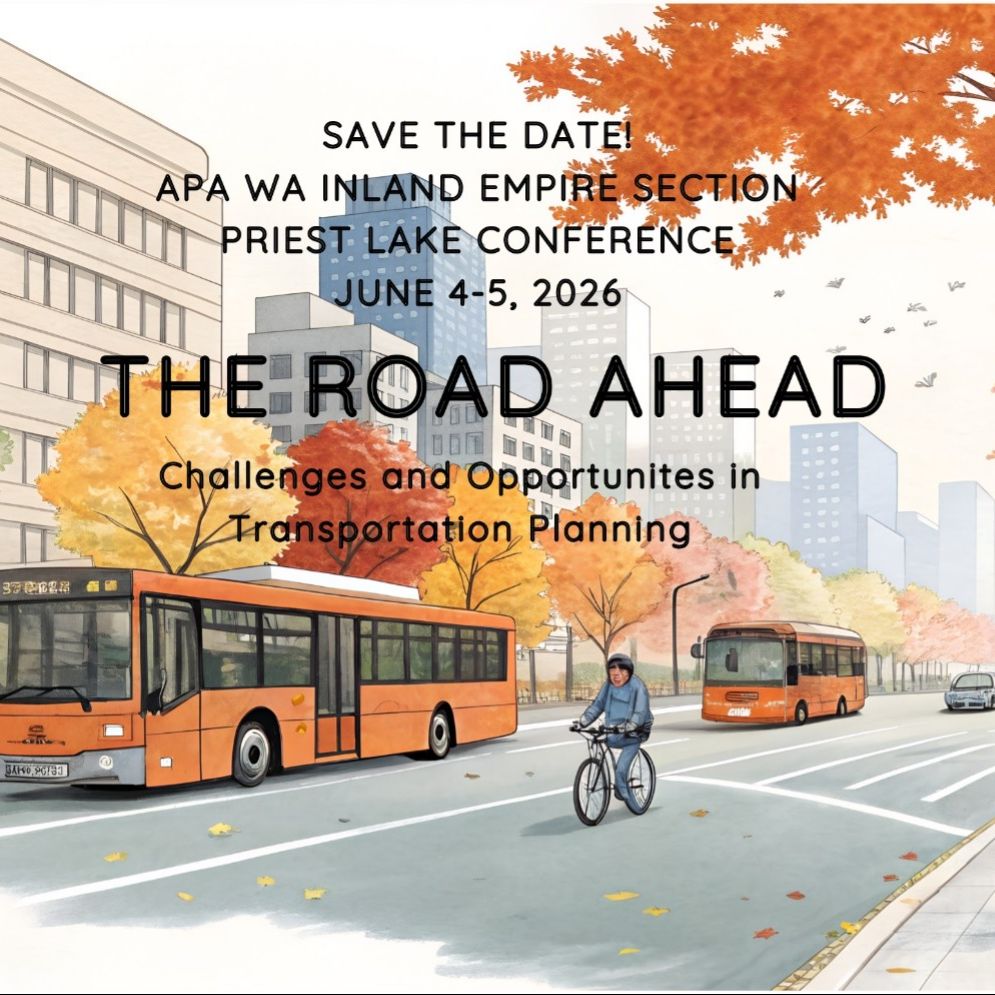
Submit Your Proposal for the Annual Priest Lake Conference
The APA Inland Empire Section invites you to submit a proposal for our annual Priest Lake Conference, which will be held from June 4 to June 5, 2026, at Elkins Resort in Nordman, ID!
Building Professional Pathways: Supporting WWU Planning Students at the 2026 APA National Conference
Western Washington University planning students are raising funds to continue the annual tradition of attending the APA National Planning Conference in Detroit. These efforts help ensure more students have access to this valuable professional opportunity.
The Spokane County Annual Point-in-Time Count: A Study in Regional Collaboration
For the third year in a row, Eastern Washington University professor, Matthew Anderson (and co-chair of Spokane County's Continuum of Care Board), has played in key role in the successful completion of Spokane County’s annual Point-in-Time Count (PiT). This census of people experiencing homelessness is part of a nationwide initiative mandated by the US Department of Housing and Urban Development (HUD).
Large-scale solar energy is expanding rapidly, but siting these projects often presents significant planning and community challenges. Rutgers University and the American Planning Association (APA) are partnering on a national survey to better understand:
Community concerns and planning bottlenecks related to large-scale solar development, and
How benefits agreements can help communities share in the advantages of renewable energy projects.
Your input will help identify how planners can support thoughtful, equitable renewable energy growth. The survey is anonymous and takes approximately 5–8 minutes to complete.
In the Safe System / Vision Zero approach to traffic safety, who is responsible for preventing deaths and serious injuries?
A. Individual road users, because crashes are primarily caused by human error B. Police enforcement, because deterrence is the main safety lever C. Transportation system designers (engineers, agencies, policymakers) — road users just follow the rules D. Shared responsibility between system designers and road users, because humans make mistakes and the system must be forgiving
The answer will be shared in next month’s newsletter.
Interested in submitting an article for the next newsletter?
Contact the APA WA Communications Committee! Email Riya Debnath and Ben Braudrick at [email protected].